Description
Research Peptide≥99% HPLC StandardShips from Canada
Overview
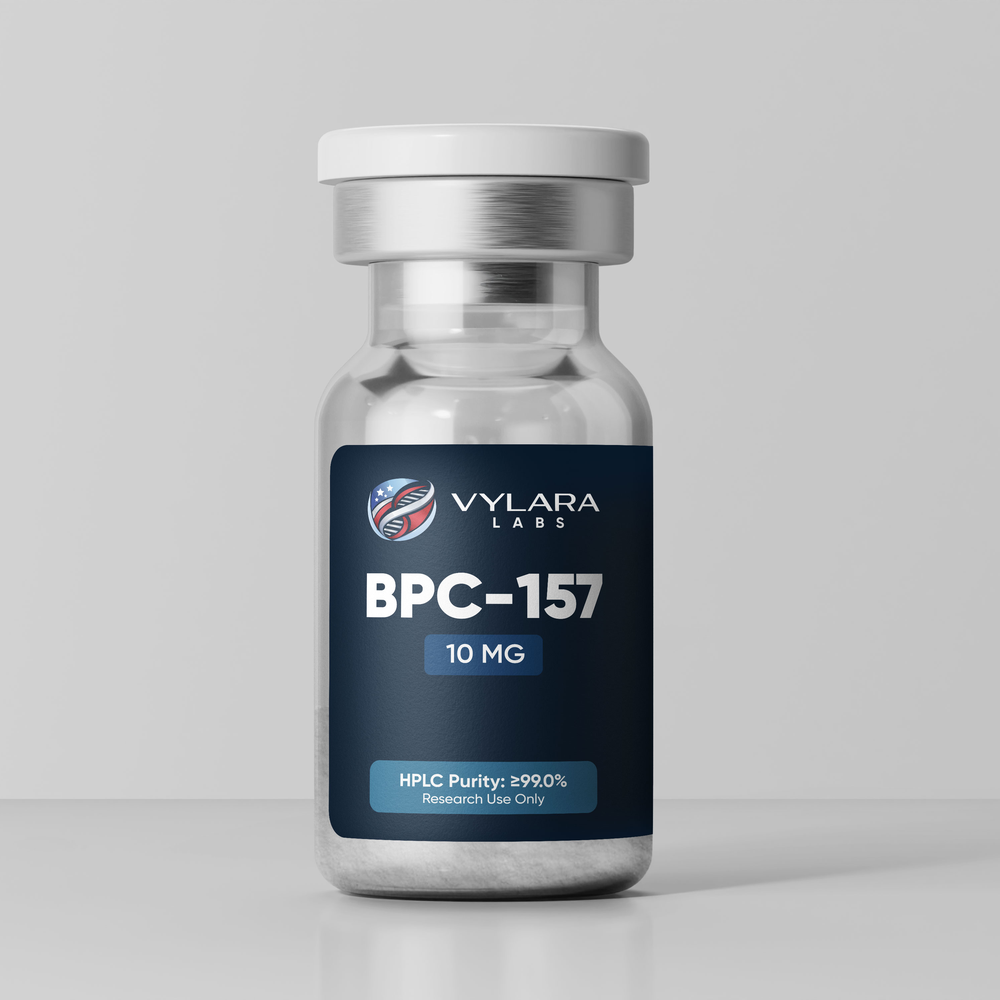
BPC-157 (Body Protection Compound-157) is a synthetic pentadecapeptide — a chain of 15 amino acids (Gly-Glu-Pro-Pro-Pro-Gly-Lys-Pro-Ala-Asp-Asp-Ala-Gly-Leu-Val) corresponding to a partial sequence of body protection compound, a protein identified in human gastric juice. It carries no cysteine residues and therefore forms no disulfide bonds, and it is notably stable in aqueous solution and in gastric acid, resisting hydrolysis under conditions that degrade many peptides. These properties make it a convenient subject for laboratory handling and for in-vitro and preclinical study.
In research settings BPC-157 is studied for its apparent influence on tissue-repair processes across several organ systems, including the vasculature, tendon and ligament, skeletal muscle, and the gastrointestinal tract. Work in cell-culture and animal models has associated it with growth-factor and nitric-oxide signalling pathways rather than a single defined receptor, and it is frequently used as a reference peptide when examining angiogenesis and cell-migration mechanisms. It is offered strictly as a research material, and the studies cited below describe preclinical and in-vitro findings only.
Mechanisms of interest in research
Angiogenesis and VEGFR2 signalling
Angiogenesis — the formation of new blood vessels from existing ones — is coordinated largely through vascular endothelial growth factor (VEGF) acting at its receptor VEGFR2. In endothelial-cell and animal injury models, BPC-157 has been associated with increased VEGFR2 expression and activation of the downstream Akt–eNOS axis, which raises nitric-oxide availability and supports endothelial tube formation and vessel sprouting. This vascular activity is a principal reason the peptide is studied in tissue-repair research.
Tendon, ligament and fibroblast repair
Repair of dense connective tissue depends on fibroblasts migrating into the wound, surviving oxidative stress, and remodelling the extracellular matrix. In cultured tendon explants and isolated fibroblasts, BPC-157 has been reported to accelerate fibroblast outgrowth and migration, effects that investigators have linked to activation of the focal adhesion kinase (FAK)–paxillin pathway governing cell adhesion and motility.
Nitric-oxide (NO) system modulation
The nitric-oxide system regulates vascular tone, platelet behaviour and cytoprotection. Across preclinical models, BPC-157 has been studied for its ability to counteract the effects of NO-synthase blockade (for example by L-NAME) and to interact with NO-overload conditions (L-arginine), suggesting it modulates rather than simply stimulates NO signalling.
Gastrointestinal cytoprotection
BPC-157 was originally isolated as a fragment of a protective protein found in gastric juice, and much of its early literature concerns the gut. In animal models of mucosal injury it has been associated with maintenance of gastrointestinal mucosal integrity and with signalling along the gut–brain axis.
Specifications
Certificate of Analysis
Representative testing for BPC-157, part of our ongoing quality program. Testing is conducted on Vylara-supplied samples of this compound.
Selected Research
The following peer-reviewed studies are provided for scientific context on this compound’s research background. They describe preclinical and in-vitro findings only and are not claims about this product.
In cultured tendon explants and fibroblasts, BPC-157 increased fibroblast outgrowth, cell survival under oxidative stress, and cell migration, effects the authors linked to activation of the FAK–paxillin pathway.
Chang CH, et al. J Appl Physiol. PMID: 21030672
A review of BPC-157 and the vasculature describes it as an angiomodulatory agent acting through nitric-oxide, VEGF and FAK-related pathways to influence angiogenesis and vascular responses in injury models.
Seiwerth S, et al. Curr Pharm Des. PMID: 23782145
A review of BPC-157 in wound healing summarizes preclinical findings across multiple wound types, associating the peptide with resolution of vessel constriction and support of the platelet-plug and fibrin phases of healing.
Seiwerth S, et al. Front Pharmacol. PMID: 34267654
A review of musculoskeletal soft-tissue studies reports consistently positive healing effects of BPC-157 across injury types in animal models, while noting that efficacy in humans is not established and that mechanisms require further study.
Gwyer D, et al. Cell Tissue Res. PMID: 30915550
This product is intended exclusively for in-vitro laboratory research. It is not a drug, food, dietary supplement, or cosmetic, and it is not intended for human or veterinary diagnostic, therapeutic, or recreational use.