Description
Research Peptide Blend≥99% HPLC StandardShips from Canada
Overview
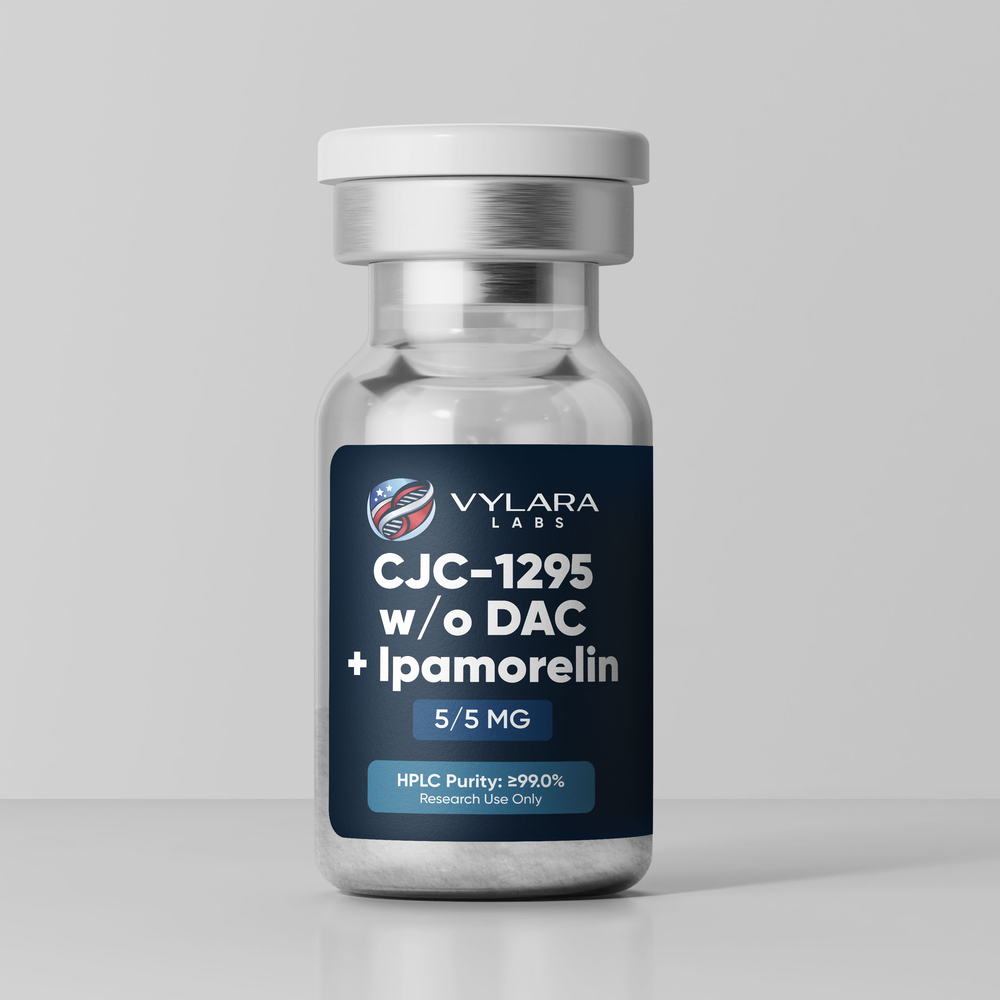
This research blend co-lyophilizes two peptides in a single vial: CJC-1295 without DAC (also called Modified GRF 1-29, a protease-resistant fragment of growth-hormone-releasing hormone) and Ipamorelin (a selective ghrelin-receptor agonist). It is intended for combined-exposure studies.
The pairing is of research interest because the two act at different receptors that both feed the growth-hormone axis — CJC-1295 at the GHRH receptor and Ipamorelin at the GHS-R1a (ghrelin) receptor — a combination used to examine complementary GH-releasing signals. No published study evaluates this specific blend; the references below concern the individual components. It is offered strictly as a research material, and the studies cited describe preclinical and clinical-pharmacology findings only.
Mechanisms of interest in research
CJC-1295 (GHRH pathway)
The GHRH-analog component activates the GHRH receptor on pituitary somatotrophs to promote GH synthesis and release; its protease-resistant sequence prolongs this signal relative to native GHRH.
Ipamorelin (ghrelin pathway)
The ipamorelin component activates the GHS-R1a receptor selectively, releasing GH with little effect on cortisol or prolactin, and is studied as a complementary trigger acting through a separate receptor.
Specifications
Selected Research
The following peer-reviewed studies are provided for scientific context on this compound’s research background. They describe preclinical and in-vitro findings only and are not claims about this product.
On CJC-1295:
In healthy adults, single doses of CJC-1295 produced dose-dependent, multi-day increases in mean plasma GH and IGF-1, with an estimated half-life of about 6–8 days.
Teichman SL, et al. J Clin Endocrinol Metab. PMID: 16352683
On Ipamorelin:
In rat pituitary cells and in rats and swine, ipamorelin selectively released GH without affecting ACTH or cortisol, showing GHRH-like selectivity for a ghrelin-receptor agonist.
Raun K, et al. Eur J Endocrinol. PMID: 9849822
This product is intended exclusively for in-vitro laboratory research. It is not a drug, food, dietary supplement, or cosmetic, and it is not intended for human or veterinary diagnostic, therapeutic, or recreational use.