Description
Research Peptide≥99% HPLC StandardShips from Canada
Overview
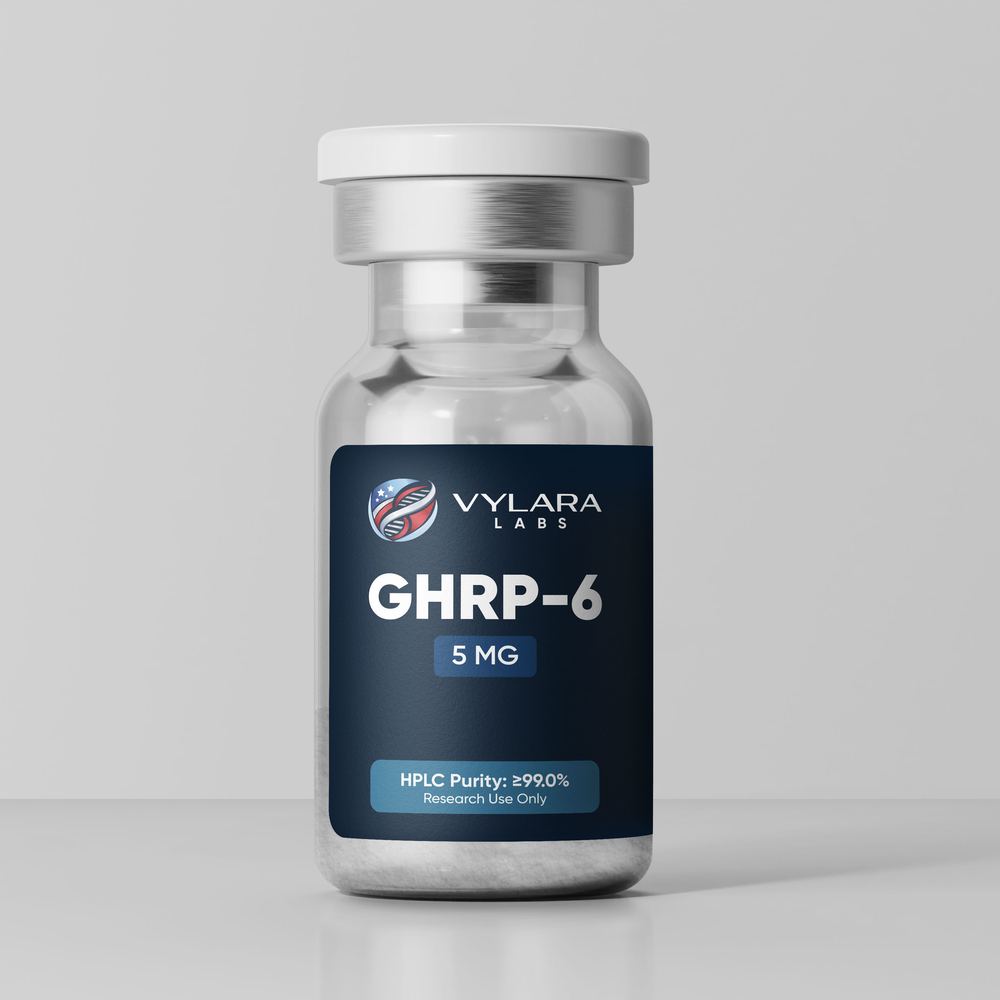
GHRP-6 (growth-hormone-releasing peptide-6) is a synthetic hexapeptide (His-D-Trp-Ala-Trp-D-Phe-Lys-NH₂) and an agonist of the ghrelin / growth-hormone-secretagogue receptor (GHS-R1a). One of the earliest peptides in this class, it is supplied as a stable lyophilized peptide.
In research it is studied as a stimulus of growth-hormone (GH) release through the ghrelin-receptor pathway and, distinctively among secretagogues, for a pronounced effect on appetite signalling. It is offered strictly as a research material, and the studies cited below describe preclinical and clinical-pharmacology findings only.
Mechanisms of interest in research
Ghrelin / GHS-R1a receptor agonism
GHRP-6 activates the GHS-R1a receptor to release GH from the pituitary, acting at a site distinct from the GHRH receptor. In model systems its GH-releasing action depends on intact hypothalamic–pituitary signalling and is often synergistic with GHRH.
Orexigenic (appetite) signalling
As a ghrelin-receptor agonist, GHRP-6 is also studied for orexigenic effects — stimulation of food intake — mediated through hypothalamic pathways, a feature more prominent with GHRP-6 than with more GH-selective secretagogues.
Growth-hormone axis and downstream endpoints
Through sustained GH signalling, GHRP-6 has been examined in longer-term animal models for effects on body weight and bone as readouts of GH-axis activation.
Specifications
Selected Research
The following peer-reviewed studies are provided for scientific context on this compound’s research background. They describe preclinical and in-vitro findings only and are not claims about this product.
In patients with pituitary stalk transection, the GH response to GHRP-6 was almost completely abolished, indicating that its GH-releasing action depends on intact hypothalamic–pituitary connectivity.
Pombo M, et al. J Pediatr Endocrinol Metab. PMID: 8887178
In adult female rats, GH-releasing peptide-6 (with ipamorelin) increased body weight and total bone mineral content, though the bone-mineral gain was not significant once corrected for body weight.
Svensson J, et al. J Endocrinol. PMID: 10828840
This product is intended exclusively for in-vitro laboratory research. It is not a drug, food, dietary supplement, or cosmetic, and it is not intended for human or veterinary diagnostic, therapeutic, or recreational use.